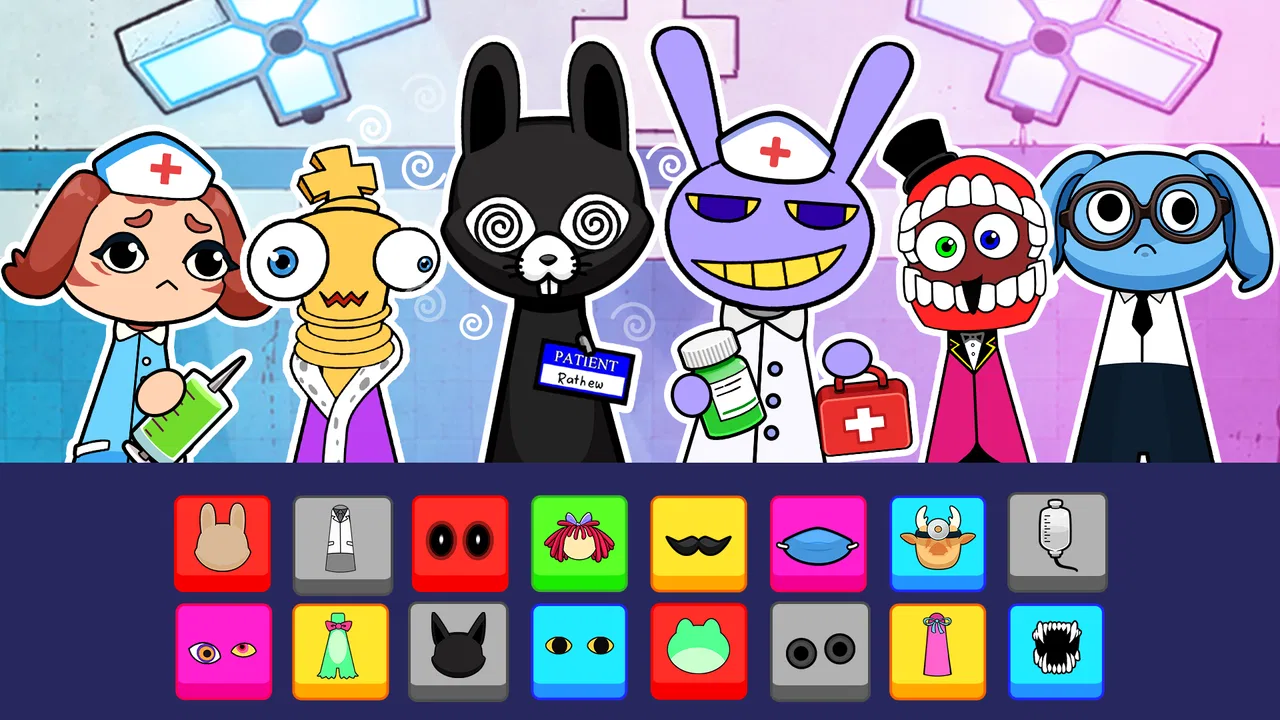
Meme Cute Beats
- 4.6
- Rating
- 1.00M
- Installs
- Free
- Price

 Analysis by App-foxy
I went into Meme Cute Beats expecting a lightweight music toy, and that is exactly where it makes the most sense. This free music game from VGP Studio is built around combining cute sounds and playful beats rather than following a traditional story, competing through complex levels, or learning formal music theory. My first impression was that the appeal comes from immediate experimentation: choose a sound, add another, listen to the result, and decide whether the mix is funny enough to keep or worth rebuilding.
That simple loop gives the game a friendly personality. It feels aimed at people who want a quick creative distraction, especially when they have a few spare minutes and do not want the commitment of a full rhythm game or a serious music-production app. The store places it in the Music category, but I would describe it more precisely as a casual beat-making playground with game-like feedback. That distinction matters because it is enjoyable for spontaneous sound experiments, while it is not a replacement for a sequencer, instrument-learning app, or professional audio workstation.
How the first sound turns into a playable session
The first action is deliberately approachable. Instead of beginning with a technical setup, I can start by trying a sound and then layering another beat around it. The pleasure is in hearing the contrast between individual cute effects and the combined track. A sound that seems silly on its own can become surprisingly effective once it has a rhythmic partner, while two loud or exaggerated choices can make the result intentionally chaotic.
You May Also Like

 Blood Strike: 2.5 Anniversary
Blood Strike’s Loadouts Turn Every Drop Into a Tactical Gamble
A close look at Blood Strike’s custom loadouts: how fast access to signature weapons reshapes its battle royale rhythm, rewards preparation, and narrows the gap between fights.

 Pandora - Music & Podcasts
Pandora’s Music Is Easy to Start, but Harder to Recover
Pandora’s strength is its low-effort path from a seed to a station. Its weak spot is how much confidence it asks you to place in connection, setup, and quiet recovery.

 8 Ball Pool
 Is Built on Rivalries, Rematches, and Routine
A close look at the rivalries, rematches, shared routines, and unanswered safety questions that turn a quick pool match into a persistent mobile community.

 Samsung Music
’s Quiet Strength Is Playing What You Already Own
Its reach comes less from spectacle than from dependable access to a personal library. That simplicity is both the app’s strongest retention engine and its ceiling.

 AccuWeather: Weather Radar
AccuWeather Review: A Quick, Clear Forecast for Everyday Decisions
For everyday plans, the best forecast is the one you can understand quickly. AccuWeather makes rain timing, radar, and local conditions easy to act on, with a few trade-offs.

 Hill Climb Racing
Why Hill Climb Racing Still Turns Crashes Into One More Run
A tiny car, a bumpy hill and one more upgrade: Hill Climb Racing keeps resurfacing because its simple chaos makes every near-miss feel personal.
More From Our News Desk
View All News


This makes the opening moments less intimidating than many music apps. I do not need to understand notation, tempo controls, recording terminology, or a complicated arrangement screen before I can hear something. For a younger player, a casual user, or someone who normally avoids music software, that low barrier is a real strength. The Teen content rating also gives a useful indication that this is not positioned as a preschool-only toy, even though its visual and audio style is clearly playful.
One useful way to approach it is to treat each new track as a tiny question: what happens if I keep the main beat and replace only the funniest sound? That method is more rewarding than tapping everything at once. It lets me notice which combinations create a clear pulse and which ones bury the rhythm. I found that making one change at a time gives the game more character, because the feedback becomes easier to understand.
The game’s central action is therefore not simply selecting sounds. It is making a quick creative decision, hearing the consequence, and deciding whether the new version is better. That keeps the experience active even when the controls are simple. I am not just consuming a song; I am shaping a small musical joke and testing whether the pieces work together.
Why the feedback rhythm matters
The strongest part of the experience is the immediate relationship between action and sound. When a new beat fits, the result feels more complete at once. When it clashes, I know quickly that the mix needs another attempt. That instant response is important because casual games lose their appeal when a player must wait through menus or long rounds before understanding whether a choice mattered.
The feedback is also what separates this from simply browsing a library of funny audio clips. A clip on its own may get a laugh once, but arranging several sounds gives me a reason to listen again. The rhythm provides a frame, and the cute effects become more expressive when they land against it. Even a failed combination has value because it shows me what not to repeat in the next attempt.
I would not call the game a precision rhythm challenge in the same way as a title that asks me to hit notes on exact beats. Its satisfaction comes from arranging and reacting rather than proving fast reflexes. That makes it more forgiving, but it also means players looking for demanding timing tests may find the interaction too relaxed. The game works best when I want playful musical feedback, not a high-pressure performance.
A practical tip is to listen for balance rather than novelty alone. The funniest sound is not always the best foundation. I get better results by finding a beat that gives the track a recognizable shape, then adding unusual sounds as accents. This small change in approach makes the creations feel less like a pile of effects and more like short, deliberate pieces.
Another worthwhile habit is to pause mentally after each addition. Because the game encourages quick tapping, it is easy to fill the arrangement before noticing what changed. Building gradually gives each sound a job: one can establish the pulse, another can add a response, and a third can provide the comic surprise. That workflow is a more rewarding use of the game than chasing random combinations.
What counts as a reward here
The reward is mainly experiential. I get the satisfaction of hearing a combination come together, discovering a sound pairing I want to replay, and producing something that feels recognizably mine. This is a different reward structure from unlocking a long campaign or improving a character. The track itself is the payoff, and the curiosity to make a better or stranger version is what pulls me forward.
That can be especially appealing in short sessions. If I am waiting for an appointment or taking a break from work, I can make a small arrangement without needing to remember a complicated objective. The game gives me a clear endpoint: I have tried a mix, heard it, and can either accept the result or start experimenting again. It is easy to put down because the commitment is small, yet easy to reopen because one more combination might sound better.
The free entry point helps with that casual role. I can try the core idea without paying upfront, while optional in-app purchases range from $0.99 to $19.99 per item. I would keep that in mind before treating the game as a completely cost-free hobby. The basic invitation is accessible, but anyone who becomes interested in optional items should check each purchase carefully and decide whether it adds enough creative value to justify the expense.
For me, the best reward is not collecting everything. It is finding a repeatable creative process. I might begin with a steady beat, add a contrasting cute sound, remove the weakest layer, and then test one replacement. That turns a few taps into a tiny arrangement exercise. It also prevents the experience from becoming empty novelty after the first few minutes.
There is a social use case too, even without making the game into a serious collaboration tool. I can hand the phone to a friend and ask them to choose the next sound, then compare the result with my own choice. That makes the game useful at a casual gathering or during a break with someone else. The appeal comes from the shared reaction to the mix, not from needing a winner.
The reset is part of the fun
The reset is what keeps the loop alive. Once a track has reached the point where I have heard its idea, I can start over instead of forcing the same arrangement to remain interesting. That clean break matters because the game’s pleasure comes from variation. A reset is not a punishment for failure; it is an invitation to approach the same small collection of musical decisions differently.
I like using a deliberate reset rather than endlessly repairing a weak mix. If the rhythm feels crowded, I begin again with a simpler base. If the result is too predictable, I change the first sound instead of adding more layers. This gives each session a different starting mood and makes the next attempt feel like a new experiment rather than a correction exercise.
The reset also keeps the game from demanding a large time investment. I can finish a micro-session after one satisfying combination, or continue because the previous arrangement suggested another idea. That flexibility is valuable on mobile. It suits players who want something between a music toy and a conventional game: enough interaction to occupy the mind, but no obligation to complete a chapter or protect a long run.
There is a trade-off, though. If I want persistent progression, a deep unlock system, or a strong sense of long-term mastery, this loop may feel too light. Repeating the action of choosing, listening, and rebuilding is enjoyable only if I genuinely like experimenting with sound. Players who prefer clear missions, ranked outcomes, or increasingly difficult challenges may be better served by a traditional rhythm game.
Where it fits among music apps and games
Compared with a music-production app, this game is far easier to approach but much less suited to detailed composition. A production tool usually rewards patience with control over structure, editing, and technical choices. Meme Cute Beats instead rewards instinct. I can reach an amusing result quickly, but I should not choose it when my goal is to create a polished song with precise arrangements.
Compared with a conventional rhythm game, it removes much of the pressure. I am not primarily chasing accuracy against a scrolling note pattern. The focus is on sound selection and the character of the resulting beat. That makes it more welcoming for relaxed play, but it may not provide the adrenaline or measurable skill growth that rhythm-game fans expect.
Compared with a simple soundboard, it offers a stronger reason to return because the sounds interact. The important difference is the loop: action creates an audible change, the change suggests a reward, and the reset opens another possibility. A soundboard can be funny for a moment; this game gives the humor a structure. That structure is modest, but it is enough to turn isolated effects into repeatable play.
The audience is therefore quite specific. I would recommend it to someone who enjoys cute audio, meme-style humor, casual creation, and short experiments. It is also a reasonable first step for a person curious about beat-making but unwilling to learn a complex interface. I would skip it if I wanted realistic instruments, serious composition tools, demanding timing challenges, or a story-driven game with substantial progression.
Everyday use and practical expectations
Imagine having ten minutes before leaving home. A long game would be inconvenient, while a full music app might require too much setup. Here, I can open a session, establish a beat, try a couple of sound combinations, and reset when one arrangement becomes cluttered. If a particular mix makes me laugh, I can stop there; if it sounds almost right, I can spend the remaining time refining the idea.
That same short-session design works during a commute or a break, provided I am in a place where playing audio is appropriate. I would use headphones around other people, especially because funny sound effects can be more noticeable than expected. The game’s appeal depends on hearing the interaction between layers, so playing silently may make the experience less satisfying than it is meant to be.
On the technical side, it supports devices running Android 8.0 or later. The current version is 0.0.29, which places the game in an early version stage from a user’s perspective. I would keep expectations realistic: a compact music game can be enjoyable without feeling fully expansive, and an early version may feel more focused than a mature, feature-heavy alternative. The important question is whether the central sound-mixing loop already matches what I want from a casual game.
The game has passed the point of being an obscure experiment, with over a million installs and an average rating of 4.5 from around 9,500 ratings. Those figures suggest that the basic concept has found a substantial audience, but they do not change the personal fit question. A popular casual game can still be wrong for someone who needs deep progression, and a simple game can still be exactly right for someone who wants a quick creative break.
Small choices that improve the experience
I get more from the game when I avoid judging a track too quickly. The first few seconds can sound odd because the layers have not found their relationship yet. Instead of deleting immediately, I listen for the moment when the beat establishes itself. Sometimes the comic effect works because the unusual sound arrives after a predictable pattern, not because it is inherently stronger.
I also recommend creating a personal rule for each session. One session might allow only a few layers, while another can focus on replacing the most repetitive sound. These limits make the experiment more intentional and prevent the reset from becoming mindless tapping. The game is simple enough that the player has to supply some of the structure, and that freedom is both its charm and its responsibility.
For parents or guardians considering it for a teenager, the Teen rating is worth noting before installation. I would also explain that the game is free to start but includes optional purchases, then review purchase settings on the device if needed. That conversation is more useful than presenting it as either a completely free toy or a serious music-learning product. It is a casual creative game with a playful tone and a purchase path for optional items.
For someone deciding whether to spend money inside it, I would first play enough free content to answer one question: do I enjoy rebuilding tracks after the first joke wears off? If the answer is yes, an optional item may support a hobby I already like. If the answer is no, paying will not fix the central issue, because the core appeal remains the repeated process of arranging, hearing, and starting again.
My verdict on the complete loop
The action is clear: choose and combine sounds. The feedback is immediate: the beat either gains personality or becomes a reason to try another arrangement. The reward is hearing a small creation that feels amusingly personal. The reset is quick and useful, giving me a fresh starting point instead of making a failed mix feel final. That sequence explains why another session begins even though the game does not need a complicated plot or elaborate challenge structure.
My main reservation is also tied to that simplicity. The same loop that makes Meme Cute Beats approachable may leave experienced musicians and competitive players wanting more depth. Its value depends on whether I enjoy playful variation more than measurable progression. I would not install it expecting a full studio, an instrument tutor, or a demanding rhythm test.
For the right player, however, the focused design is a strength. VGP Studio has made a music game that is easy to enter, quick to understand, and flexible enough for both solo tinkering and casual sharing. I especially like that a failed combination is not wasted; it becomes information for the next reset. That makes the experience feel more creative than a simple collection of novelty sounds.
Meme Cute Beats is worth trying if you want a free, lighthearted way to build funny little tracks and you are happy for the music itself to be the reward. I would recommend it to casual players, meme-audio fans, and beginners who want experimentation without technical pressure. I would point serious composers and high-intensity rhythm players elsewhere. For everyone in between, the best approach is to start with one beat, add sounds carefully, listen for the moment the mix clicks, and reset without hesitation when it does not.
FAQs for Meme Cute Beats
01What is Meme Cute Beats and how does it work?
Meme Cute Beats is a rhythm-based game available on Android and iOS where players tap to the beat of catchy music tracks. The game combines elements of music and memes, offering a unique and fun experience. Players can choose their favorite memes as characters and compete in various levels. The app uses touch controls to sync your taps with the rhythm, providing an engaging and challenging gameplay.
02Is Meme Cute Beats free to download and play?
Yes, Meme Cute Beats is free to download and play. However, the app offers in-app purchases for additional features, such as exclusive meme characters, special tracks, and ad-free experiences. While the core game is accessible without spending money, these optional purchases can enhance the gameplay and provide further customization for dedicated players.
03What are the minimum device requirements for Meme Cute Beats?
To ensure smooth gameplay, Meme Cute Beats requires a device running Android 5.0 or later or iOS 11.0 or later. It's recommended to have at least 2GB of RAM and a stable internet connection for downloading updates and accessing online features. The game is optimized for both tablets and smartphones, but performance may vary based on your device's specifications.
04Can I play Meme Cute Beats offline?
Meme Cute Beats can be played offline, allowing players to enjoy the core gameplay without an internet connection. However, certain features, such as downloading new tracks, accessing leaderboards, and participating in online events, require an internet connection. Offline play is ideal for enjoying the game on the go without relying on Wi-Fi or mobile data.
05Is Meme Cute Beats suitable for all ages?
Meme Cute Beats is designed to be family-friendly and suitable for players of all ages. The game features colorful graphics, catchy music, and meme-inspired humor that can appeal to both children and adults. Parental guidance is recommended for younger players due to the presence of in-app purchases, ensuring that spending is controlled and supervised.
Pros
- User-friendly interface for easy navigation.
- Wide range of meme templates available.
- Customizable beat options enhance creativity.
- Quick sharing to social media platforms.
- Regular updates with new content.
Cons
- Occasional ads can interrupt workflow.
- Limited advanced editing features.
- Requires internet for full functionality.
- Some templates are only available in premium.
- App size is larger than similar apps.

Meme Cute Beats
Gallery